The Rim Road Walk: Kern Place's Best View Isn't of the Mountains
August 13, 2026
August 13, 2026
Ask a Kern Place resident where to watch the sun go down and most people point west, toward the Franklins, toward Mount Cristo Rey glowing orange over New Mexico. That's the postcard answer. It's also not what Rim Road was actually built to show you.
Walk the upper curve of Rim Road at golden hour and the mountains are there, sure, off to the side. But the street itself, the way it climbs and bends, was laid out to frame something closer and lower: the rooftop of El Paso High School, sitting in the flats below like it was placed there on purpose. It mostly was.
Kern Place sits on a shelf of land above downtown, and Rim Road runs along the literal edge of it. The neighborhood's southeastern boundary is Billy Rogers Arroyo, the drainage channel that has always marked where the flat streets end and the climb begins. Rim Road doesn't just have a rim. It is one. The street traces the top edge of the arroyo before the land keeps rising toward Crazy Cat Mountain, one of the lower folds of the Franklins that gives the eastern edge of the neighborhood its shape.
Most people who've lived here for years know the street feels different, higher, quieter, older. Fewer know the name is describing the geology under their feet, not a marketing flourish.
Kern Place was platted starting in 1914 by Peter E. Kern, who hired an engineer named W.I. Rider to lay out curving streets instead of a grid, wrapping them around parks rather than through them. A 1914 ad in the El Paso Herald pitched the subdivision on horse trails, planned green space, and homes under $3,500, back when that number meant something entirely different.
Kern had one rule that shaped everything downstream: no commercial property on his land. Not a corner store, not a shop, nothing that would compete with the houses for attention. In 1915 he handed the city 500 newly planted trees along with the land under them, which became Madeline Park, named for his daughter. The old entrance gate he built the following year carried a motto about "the brotherhood of man, light, life, health and wealth," his own description of what he thought a neighborhood should stand for.
That covenant is why Rim Road, the highest and most private street in the subdivision, never developed the thing you'd expect at the top of a hill in most cities: a club, a lookout restaurant, a gated amenity. Kern's rule meant there was nothing to build up there except more houses. So the view stayed open, and the only large structure it could possibly frame was something Kern didn't own and never controlled.
That structure is El Paso High School, completed in 1916 by the architecture firm Trost & Trost, the same year Kern's own iron gate went up nearby. Henry C. Trost's portfolio from that era also includes the O.T. Bassett Tower downtown and the hotel building that would later carry the Hilton name, among the earliest properties to do so.
Rim Road residents have been looking at a Trost building since before most of the houses on the street existed. It's a strange kind of civic view for a private street to have. Kern Place's most exclusive address doesn't overlook a golf course or a private amenity. It overlooks a public high school designed by the most significant architecture firm the region has produced, because the man who built the street refused to let anything else go there.
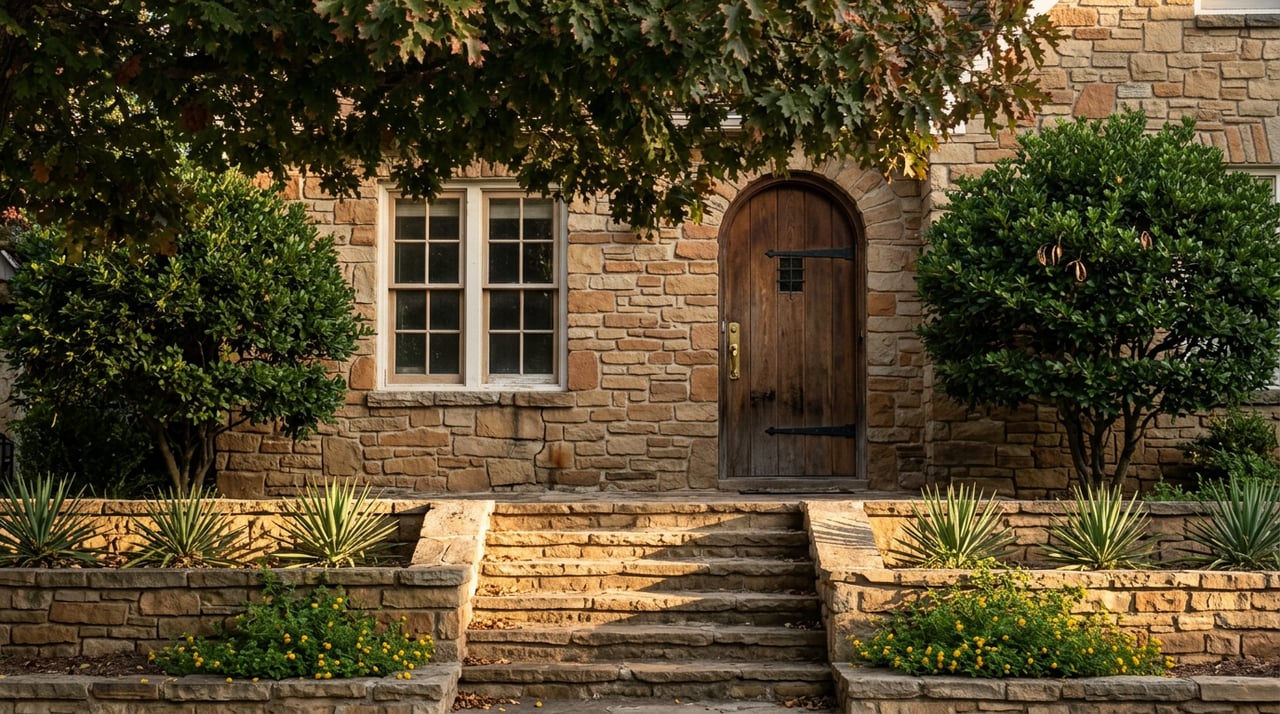
The climb up Rim Road passes through nearly the full span of the neighborhood's architectural history in a few blocks. Kern Place's housing stock runs from bungalows built in the 1910s to ranch houses from the 1950s, stone cottages sitting a few doors down from Federal-style houses that would look more at home on the East Coast.
A few blocks over on East Baltimore Drive sits the Gustavus A. Trost House, built in 1923 by the same Trost & Trost firm, for a client who shared the firm's name. It's a small, easy detail to miss, but it means the firm responsible for the building at the bottom of the Rim Road view also has a namesake house tucked into the same neighborhood, on a completely different street. On McKelligon Drive stands the Robert Massey House, a flat-roofed, stone-walled 1955 design by David Hilles, his first completed house in El Paso and a sharp departure in style from everything built here in the decades before it.
None of these houses are on Rim Road itself. They're worth knowing about because they explain what you're walking past on the way up: not a single architectural moment but four decades of them, stacked into a few curving blocks because Kern's plan never allowed the neighborhood to sprawl or standardize.
| The 1914 pitch | The version that still exists |
|---|---|
| Horse trails | A paved walking loop through Alethea Park |
| Planned parks woven into the street layout | Madeline Park and Alethea Park still anchor the curves Rider designed |
| No commercial property | Retail and restaurants still cluster on Cincinnati Avenue, not on Rim |
| Access to public transportation | Sun Metro service still runs through the neighborhood today |
The specifics changed. The underlying shape of the place, park-centered streets with no commercial pressure at the top of the hill, has held for well over a century.
Most people who climb Rim Road come back down through Alethea Park, a wide, paved loop that residents on Nextdoor consistently name among their favorite reasons for being here, particularly the ones walking dogs. It's a plainer stop than the view up top, open field, straight path, none of the drama of the climb, which is exactly why it works as an ending. You spend twenty minutes looking at a hundred-year-old building from a street built specifically so you could, then you walk it off on flat ground with everyone else's dog.
Next time you're up there, look past the obvious. The mountains earned their reputation honestly. But the reason Rim Road exists the way it does, curving, quiet, refusing to hold anything but houses, is a decision one developer made in 1914 that nobody since has had reason to undo.
If you're curious about other pockets of Kern Place worth knowing, or you're weighing what a home on a street like this one is actually worth holding onto, Desiree Nicole Luna has spent her career in these blocks and is always glad to talk through what she's seeing. Let's Connect.
Stay up to date on the latest real estate trends.
Every successful real estate journey begins with trust. I believe in building lasting relationships through honest communication, thoughtful guidance, and personalized service, helping you navigate every decision with confidence while making you feel supported long after closing day.